Book Review: Spirituality in Nursing: Standing on Holy Ground

 “Perhaps no scriptural theme so well models the spiritual posture of nursing practice ass the Old Testament depiction of Moses and the burning bush. In the biblical narrative God reminded Moses that, when he stood before the Lord, the ground beneath his feet was holy. For it is her, in the act of serving a brother and sister in need, that the nurse truly encounters God.” (p. 1) Mary Elizabeth O’Brien in Spirituality in Nursing:Standing on Holy Ground opening statement sets the stage for the examination of nursing practice in relation to the nurses spirituality in caring for patients, participation in providing holistic care, and the nurse’s role as a healer. O’Brien shares the results of formal and informal observations to provide guidelines for meeting the spiritual needs for the mentally and chronically ill, despair and dying, children and families and others in the diverse practice settings of nursing care.
Quite a few years back, while I reviewing books and articles written by experts, I discovered O’Brien’s Spiritual Assessment Scale (SAS). In my experience there are two-broad categories of spiritual assessment tools: brief and used with patients/clients (FICA, SPIRIT, HOPE, etc); and multidimensional assessments or scales that examine the complex dimensions of spirituality. O’Brien’s SAS captures the multidimensional aspects of spiritual health through the Christian paradigm of a relationship with God: Personal Faith, Religious Practice, and Spiritual Contentment. Since SAS can be used for research and statistical analysis, the scoring is a 5-point Likert scale ranging from “Strongly Disagree” to “Strongly Agree”. Here is an example of an assessment question for each category:
Personal Faith: “I receive strength and comfort from my spiritual beliefs.”
Religious Practice: “My relationship with God is strengthened by personal prayer.”
Spiritual Contentment: “I feel that I have lost God’s love.”
I also want to mention that O’Brien has given permission for NCFI to use the SAS in The Art and Science of Spiritual Care. The scale is used as a self-assessment for examining the participants own spiritual health. Knowing one’s self and caring for one’s spiritual health is an important part of nursing practice and essential to providing spiritual care. 
Spiritual Care is not an “add on” or “alternative/complementary” to nursing practice. This is especially true for Christians. O’Brien invites nurses welcome nurses to stand on holy ground and encounter God through our acts of service in nursing.
NCFI Cares: A Miracle Lullaby

I was recently at a hospital attending a conference where a brief, beautiful lullaby played every time a baby was born. The short 10 second tune notified all the staff, visitors, and patients on the mother/baby unit that a miracle, our Creator had breathed his life-giving Spirit into a new child. As I sat in the conference, this beautiful lullaby would attempt to interrupt the speakers with the brief proclamation of life.  I kept thinking that each time the song played, possibly 3 or 4 times that morning, how many times do we take note of the miracles in our lives? Do we notice when the Lord has miraculously intervened on our behalf? If we happen to notice the Lord’s hand in our life, do we stop our actions to pause and recognize with amazing wonder? Better yet, do we praise God for his unending grace that extends to each one of us personally throughout the day?

We can take untimely interruptions and praise God for his everlasting miracles in our world. We can celebrate his continuous abiding in our community and for his life-giving presence in each one of us. Let’s also give the Holy Spirit permission to interrupt our lives, day or night, with opportunities to praise our Creator who works miracles every day!

p.s. During the writing of this devotion, I was reminded of Michelangelo’s fresco on the Sistine Chapel ceiling “Creation of Adam”–enjoy!

Aside

My Christian Nursing Mentor

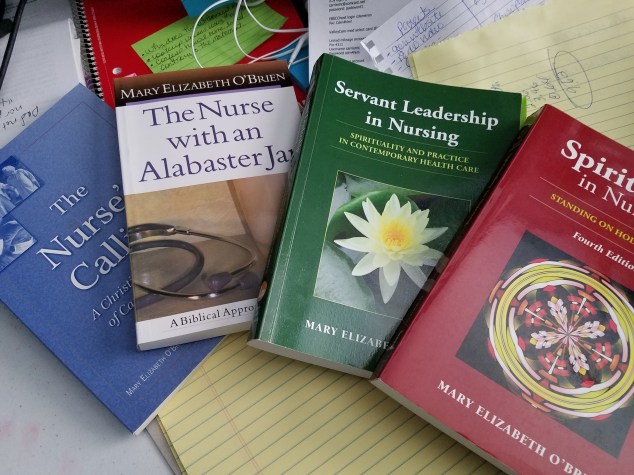
Mary Elizabeth O’Brien is an amazing Christian nursing researcher, scholar, and practitioner.  I discovered her book Spirituality in Nursing: Standing on Holy Ground while in grad school. I was researching Spiritual Care for various papers I wrote, as well as implementing Spiritual Care into an Associate Degree Nursing Program and then with The Art and Science of Spiritual Care: Train-the-Trainer project for Nurses Christian Fellowship International. Later, I discovered her other works and have used them as resources for my books and articles.

Sister Mary Elizabeth is a woman of God, a servant for Christ, and an excellent mentor. Even if it is only through her publications. She merges Scripture with the practice of nursing with a humble, compassionate and gracious spirit.  I owe my maturation as a Christian nurse to her and recommend her works be part of a Christian nurses library.

O'Brien books

 Checkout a review for each of O’Brien’s books on my Facebook page.

NCFI Cares: Students of the Master

77ba6-ncficares_3bloglogo

One of my favorite things about reading the gospels is how people would just sit at Jesus’s feet and listen to him.  For a moment, imagine sitting at the feet of Jesus as he explained the ancient scriptures in new and refreshing ways. His lectures included every day accounts of work and family as case studies in exploring God’s commands like love and tithing. He would bring applicable wisdom to challenging, confusing topics like marriage and divorce. Even God’s judgment of sin and death were filled with a new light of hope and understanding.

Contemplate the intimacy of his words as he not only spoke to the multitudes on the mountains, or on the sea shores. He spoke personally to each individual as a trusted friend or wise older brother. His language was poignant reverberating with clarity and truth enveloped in compassion and grace.

Jesus was a master teacher, orator (speaker) and mentor, thus we should be master students. Even if we have been Christians for 25 or more years, we can still be master students.

I imagine a master student being a faithful student. In addition to attentively sitting at the Master’s feet, listening and trying to absorb every word from the Teacher.  A master student would approach the discipline of faith as a living practicum focused on Disciple 101. For as a Disciple 101 student, the personal and professional lives are not broken segments of prayer, work, family, and worship; instead the studies merge all activities into a life-time internship under our Master’s guidance.

Sit at the Master’s feet and open your spirit to new ways of being a master student.

“Didn’t our hearts burn within us while he was speaking with us on the road, while he was explaining the scriptures to us?” Luke 24:32
