NCFI Cares: Faith Proclamation to the World

First, I thank my God through Jesus Christ for all of you, because your faith is proclaimed in all the world. For God is my witness, whom I serve with my spirit in the gospel of his Son, that without ceasing I mention you always in my prayers, asking that somehow by God’s will I may now at last succeed in coming to you. For I long to see you, that I may impart to you some spiritual gift to strengthen you— that is, that we may be mutually encouraged by each other’s faith, both yours and mine. (Romans 1:8-12, ESV)

We are on the countdown to the NCFI World Congress in Malaga Spain. We will convene for a Pre Congress training course from 24 to 26 of June. The Congress begins with an opening ceremony on the 27 of June. Romans 1:8-12 can guide our hearts and spirits as last-minute preparations are being made. I have pulled specific phrases to guide our thoughts and prayers.

First, I thank my God through Jesus Christ for all of you, because your faith is proclaimed in all the world.

Let’s start by thanking God for every Christian nurse and midwife attending the Congress. Their faith is a witness to the world. Pause momentarily and imagine the people impacted by each attendee’s preparation: embassy workers, airlines, managers, churches, communities, families, hotels, etc. Wow! What an amazing witness to Jesus. In addition, their faith will be proclaimed in Malaga as hundreds of nurses convene for the Congress. PTL!

For God is my witness, whom I serve with my spirit in the gospel of his Son, that without ceasing I mention you always in my prayers,

This is a great reminder to keep praying. Please continue to pray for each attendee, speaker, and staff member at the Casa Diocesana. Notice how the prayer is specific:

For I long to see you, that I may impart to you some spiritual gift to strengthen you

The prayers are specific—spiritual gifts to strengthen one another. Our theme for the congress is Strength and Courage. Prepare your heart and spirit ahead of time so that you can dispense gifts of strength and courage to at least one person during our time together.

–that is, that we may be mutually encouraged by each other’s faith, both yours and mine.

Finally, we know that we are mutually encouraged when fellow brothers and sisters come together. Your faith blesses me, and my faith blesses you. It is a joyous time of fellowship and community.

Unfortunately, some people are unable to attend the Congress. I know nurses who have been denied visas, are unable to leave personal responsibilities and face economic challenges. Our heart goes out to those who so desired to attend but cannot. You are part of the NCFI community and our loved AND valued!

We need you! We need your prayers as we endeavor to encourage nurses from more than 30 different countries. Please commit to pray for the Congress! In the NCFI Prayer Guide for April – June, 2024 contains prayer prompts for the final week of June. https://ncfi.org/resources/general-resources/ I have included the Prayer Prompts.

Pray for wisdom, love & unity for NCFI leadership meetings that will be held in conjunction with IB meetings (22-24), International & Regional Forums (28-29), and Board of Directors (1 July).  “Have you not known? Have you not heard? The LORD is the everlasting God, the Creator of the ends of the earth. (Isaiah 40:28a)
Pray everyone involved in the NCFI Congress–may they experience the Lord in a new and courageous way. May the workers at the Casa Diocesana see the love and light of Christ in each attendee.
Pray that the Lord places a hedge of protection around the families of all attendees so that they can be attentive to the Holy Spirit’s voice. “He will tend his flock like a shepherd; he will gather the lambs in his arms; he will carry them in his bosom, and gently lead those that are with young.” (Isaiah 40:11)
Pray that the Lord will equip all attendees with the courage and strength to be a bright light and loving grace to the world. “He gives power to the faint,
and to him who has no might he increases strength.” (Isaiah 40:29)
Praise the Lord for the Holy Spirit’s work during the Congress.“they who wait for the Lord shall renew their strength; they shall mount up with the wings like eagles; they shall run and not be weary; they shall walk and not faint.” (Isaiah 40:31)
Prayer Prompts for the NCFI Congress

NCFI Cares: Are You an Eli?

 
And the Lord called Samuel again the third time. And he arose and went to Eli and said, “Here I am, for you called me.” Then Eli perceived that the Lord was calling the young man. Therefore Eli said to Samuel, “Go, lie down, and if he calls you, you shall say, Speak, Lord, for your servant hears.” So Samuel went and lay down in his place. And the Lord came and stood, calling as at other times, Samuel! Samuel! And Samuel said, Speak, for your servant hears”.

(1 Samuel 3:8-10, ESV)

Samuel came into temple service as a young boy. His primary service was ministering to the Lord with his guardian, an elderly priest, Eli (1:11; 2:26). Samuel, possibly a teenager by this time, slept near the Ark of the Covenant, yet close enough to Eli, who suffered from impaired vision.  One night, Samuel is awakened by a voice, “Samuel, Samuel.”  Samuel assumes, typical for any other night, that Eli is calling him, so he checks with Eli. Not needing assistance nor having called Samuel, Eli sends the young man back to bed. This happened three times. Notice chapter 7, chapter 3, “Now Samuel did not yet know the LORD, nor had the word of the LORD been revealed to him.”  After the third visit from a confused Samuel, Eli directed Samuel to answer the Lord by saying, “Speak, LORD, for thy servant is listening.” When the Lord called Samuel this time, he was ready to listen.

As we reflect on this passage of scripture, we are reminded of Jesus’ teachings, “He who has ears to hear, let him hear.” (Matthew 11:15). Young Samuel had not been taught to know the Lord nor to hear from the Lord.”

In addition, visions by the Lord and direct word from the Lord were rare (3:1-2). Nurses and midwives frequently encounter people who do not know the Lord. It may be because they are non-believers, or maybe they are Christians, yet they cannot hear the Lord due to their current experience. This may be due to illness, disease, or a lack of faith. Samuel not only did not know the Lord but he had not been taught the word.

For us, this is knowing scripture. Many times, we encounter people who know the Lord, but they do not know the Bible. Or let’s go further and say they are not familiar enough with the Bible for it to guide their relationship with Jesus. Let’s not miss this opportunity to point out a deficit in Samuel’s training. He worked in ministry; he had grown up in the temple and had a priest as a mentor/father figure. When encountering people who know the Lord, let’s not assume they are familiar with scripture.

I see two application points in this passage. First, we can ask ourselves whether we are so familiar with the word, attuned to the Holy Spirit, and quiet in prayer that we know when the Lord is speaking to us. Or does he speak to us multiple times, and his words land on untrained ears?

Now, my favorite part of the account of Samuel is the Lord. The Lord calls Samuel multiple times. Isn’t that like our God—he calls out to Samuel in an intimate, personal way by his name. And even though Samuel was unfamiliar with his voice, God kept calling, demonstrating his unwavering love and commitment. “Samuel, Samuel.” Eli, recognizing what is happening, gives the best advice a mentor could give–tell the Lord, “Speak, for thy servant is listening.”

Thus, the second application point is God is always calling to people. We can help our patients and colleagues by being an Eli and guiding those unfamiliar with hearing God’s voice.

NCFI Cares: The Gift of Death

I am the resurrection and life. Whoever believes in me though he die, yet shall he live, and everyone who lives and believes in me shall never die. Do you believe this?”

(John 11:25-26, ESV).

Recently, my pastor spoke about the resurrection of Lazarus, which is found in John 11. He mentioned the incredible gift we have been given to die. Yes, that is what he said. We have been given the wonderful gift of death. For when we die, we will no longer be bound to this world. Instead, we will be ushered into the presence of Jesus Christ, God the Father, the Holy Spirit, the angels, and all the saints (Revelation 21). Thus, we should not be afraid of death; instead, we should welcome the time when it comes.

Like you, I was shocked to hear my pastor say this. I know I look forward to seeing Jesus face-to-face and dwelling with Him for all eternity. Yet, I have never wanted to die nor am I looking forward to my final hours on earth as a gift from Him. The more I reflected on this teaching, the more I wondered how it would change my perspective as a nurse.

How would I alter my nursing care for the terminally ill, actively dying, or elderly? In addition to treating my patients’ pain, providing comforting words, or praying for peace, could I encourage them to get ready to enjoy their gift of death? Maybe I could help them say goodbye to the suffering they have experienced in this world–a time without pain, tears, or loneliness. I would help them anticipate an eternity without racism, abuse, or evil.  And even though they will miss their loved ones, maybe I could assist them with writing a letter to each family member. Instead of words expressed as a forever goodbye, the letter would be in expectation of seeing them again after death in the presence of Jesus.

I could help them imagine what they would do when they finally did see their Savior face-to-face. Will they hug Him like a long-lost older brother they haven’t seen in years? Maybe fall at His feet with humble thanksgiving? Or would they prostrate themselves in reverence at the magnificence of His holiness?

I have always hoped that when I finally see Jesus, I would be inclined to weep shedding like Mary, that would wash his feet with my hair and tears (Luke 7:36-38; John 11:2). These wouldn’t be tears of sadness; they would be tears of gratitude for a life with Him. A life on earth and in Heaven filled with love and joy.

This Easter season let’s share our wonderful gift of death as the passage to a life of eternity with our Lord Jesus.

I have always hoped that when I finally see Jesus, I would be drawn to tears and, like Mary, would wash his feet with my hair and tears (Luke 7:36-38; John 11:2). These wouldn’t be tears of sadness; they would be tears of gratitude for a life with Him. A life on earth and in Heaven filled with love and joy. This Easter season let’s share our wonderful gift of death as the passage to a life of eternity with our Lord Jesus.

Week #10 My Red-letter Moment

The Lord says, . . . (Psalm 91:14)

In previous sections of Psalm 91 the teacher or psalmist instructed and encouraged us using his teaching points. Our lesson plan included comparing the protection of the Lord to a mother bird and the Lord’s security to a fortress. We were recently reminded that, if needed, the Lord will even send his angels to our aid. Now at verse 14, we see a change in the narration with the use of “I” or the phrase “Lord says”. It is as if our teacher has stepped aside to invite the Lord to continue our lesson. And like a classroom filled with restless students that suddenly quiet when the principal walks in, the reader is beckoned to pay attention.

The Master and Scholar has personally come to emphasize our lesson. Like the red-letter print in the New Testament used to signify the words of Jesus, these are personal words of Yahweh. The lesson has changed from a group discourse to an intimate moment from the Almighty. He is reaching out to us individually, in love and patience, to emphasize his truth needed for our lives. A quick reader can miss this interruption. So let’s take time and wait to see what our Master has to say.

Write out and memorize: Psalm 91:14

Reflect:­ What red letter words is the Lord saying to you specifically today? If recent life events has quieted the Lord’s voice, then turn to the book of John and start reading Jesus personal words.

Prayer: Jesus, you promise as your precious children we can hear your voice as you speak to us. Open our hearts and minds to hear your voice amidst the noisiness of our world. Amen. (Luke 24:45; John 10:27)

NCFI Cares: God’s Name in Nursing–Yahweh Rapha

As nurses one of our favorite names of God is Yahweh Rapha—the God who Heals. God used the name to describe himself to the Israelite’s in Exodus 15:26. As the Son of God, Jesus demonstrated the same healing characteristics through miraculous healings and resurrections. Many times Jesus emphasized the importance of faith for miraculous healings: “Jesus said to him, ‘Receive your sight; your faith has healed you.’“ (Luke 18:42). Does this mean Yahweh Rapha heals when we have faith? Of course not, non-believers are healed all the time. Instead, the emphasis on faith, points out our belief in God as Yahweh Rapha. For example, do we have confidence in the Lord to heal every disease, every illness, every deformity, every trauma, and every ‘fill-in-the-blank’? Do we believe the same miracles that occurred in the Bible can happen today? Is our faith, which is probably smaller than a mustard seed, enough to confidently say, Jesus can raise the dead?

God's Name Wordcloud2

Other questions to reflect upon are: Are we content with the healing God does provide? Or do we get bitter when his sovereign wisdom chooses not to heal?  Or maybe, an even more profound question is: In this day of surgeries, treatments, and cutting-edge technology, do we even need Yahweh Rapha for healing? Or do we only run to him when the prognosis is bleak? One Bible scholar had a poignant reminder, “God answers every prayer. We just don’t like it when he says “no” or when he provides the answer we don’t want”. The same is true for healing. God does heal everyone, every time. We just may not see his miracle until we come to our eternal dwelling.

As we consider how healing interfaces with our faith, God’s Name–Yahweh Rapha includes the realization that God is sovereign in how his healing power is dispensed to our patients, our families, and to ourselves. “I will have mercy on whom I have mercy, and I will have compassion on whom I have compassion” (Exodus 33:19; Romans 9:15), while trusting in his everlasting lovingkindness (Psalm 136).

NCFI Cares: In the Garden with Jesus

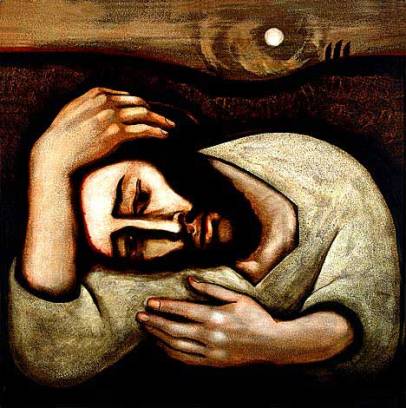
With Easter fast approaching and Christians around the world preparing to celebrate the resurrection, the tendency may be to rush past the pain and suffering our Lord endured. He invites us into the garden and into his experience: “My soul is deeply grieved, even to point of death. Remain here and stay awake with me.” (Matthew 36:39). Amidst his anguish and turmoil, we can learn from our Master to steadfastly pray, to endure suffering, and to welcome death as a path to life with him. (Romans 6:8; 8:17). Use the hymn below entitled, “Go to Dark Gethsemane” as a meditation or reflection as we spiritually accompany our Lord through his suffering.

Go to dark Gethsemane,

Christ In Gethsemane

Christ in Gethsemane by Michael D. O’Brien

You who feel the tempter’s pow’r;
Your Redeemer’s conflict see;
Watch with Him one bitter hour;
Turn not from His griefs away;
Learn of Jesus Christ to pray.

Follow to the judgment hall;
View the Lord of life arraigned;
O the worm-wood and the gall!
O the pangs His soul sustained!
Shun not suff’ring, shame, or loss;
Learn of Him to bear the cross.

Calv’ry’s mournful mountain climb
There’ adoring at His feet,
Mark the miracle of time,
God’s own sacrifice complete:
“It is finished!” Hear the cry;
Learn of Jesus Christ to die.

Early hasten to the tomb
Where they laid his breathless clay;
All is solitude and gloom;
Who hath taken Him away?
Christ is ris’n! He meets our eyes:
Savior, teach us so to rise.

GYouTube video: https://youtu.be/vD6tcMroY0A

Hymnal w/ music: https://hymnary.org/text/go_to_dark_gethsemane

NCFI Cares: Students of the Master

77ba6-ncficares_3bloglogo

One of my favorite things about reading the gospels is how people would just sit at Jesus’s feet and listen to him.  For a moment, imagine sitting at the feet of Jesus as he explained the ancient scriptures in new and refreshing ways. His lectures included every day accounts of work and family as case studies in exploring God’s commands like love and tithing. He would bring applicable wisdom to challenging, confusing topics like marriage and divorce. Even God’s judgment of sin and death were filled with a new light of hope and understanding.

Contemplate the intimacy of his words as he not only spoke to the multitudes on the mountains, or on the sea shores. He spoke personally to each individual as a trusted friend or wise older brother. His language was poignant reverberating with clarity and truth enveloped in compassion and grace.

Jesus was a master teacher, orator (speaker) and mentor, thus we should be master students. Even if we have been Christians for 25 or more years, we can still be master students.

I imagine a master student being a faithful student. In addition to attentively sitting at the Master’s feet, listening and trying to absorb every word from the Teacher.  A master student would approach the discipline of faith as a living practicum focused on Disciple 101. For as a Disciple 101 student, the personal and professional lives are not broken segments of prayer, work, family, and worship; instead the studies merge all activities into a life-time internship under our Master’s guidance.

Sit at the Master’s feet and open your spirit to new ways of being a master student.

“Didn’t our hearts burn within us while he was speaking with us on the road, while he was explaining the scriptures to us?” Luke 24:32

NCFI Cares: Jesus as our Role Model by Tove Giske, NCFI President

77ba6-ncficares_3bloglogo

As Christian nurses, we have Jesus as our source of strength and our role model. In this NCFI Cares I want to share with you how Jesus sees all of us from the God’s Kingdoms perspective. This perspective teaches us how to see and think about people and thus how to care for patients and their family and collaborate with our co-workers.

We read about Jesus who met the Samaritan women at the well in John 4:1-26. Jesus sees the woman and knows who she is; still he decides to spend time with her. As we read the text, we can sense the gentleness and the intensity of their conversation, and how Jesus touches her deep in her spirit. She becomes convinced that she has met the long waited Messiah. This makes her a witness for Christ

In Luke 19:1-10 we read about Zacchaeus up in the tree. Again, Jesus acts beyond the rules and norms and sees to the heart and longing of this man. He greets Zacchaeus up in the tree and invites himself to dinner with him. This transforms Zacchaeus. Jesus acknowledges this sinner to be a saved son of Abraham, and Zacchaeus’ transformed heart shows in action.

Jesus often asks questions when he teaches and meets with people, have you noticed that? He is interested in understanding people, who they are and how they think. Having Jesus as our role model challenges us to consider – am I interested in understanding people? Do I take the time to stop and listen to the one on my way that needs me? One of the stories I like the best from the gospels is the one about the blind beggar outside Jericho (Luke 18:35-43). Try to imagine the crowd of people and all the noise. In the middle of this, Jesus recognizes the one that needs him. He stops and askes this wonderful question: “What do you want me to do for you?”

Will you join me in following Jesus’ example and practice this question: “What do you want me to do for you?” It would be interesting to hear from your experience from using this question. Feel free to send Tove an email response at president@ncfi.org


God bless you,

Tove Giske

NCFI President


NCFI Cares: Our Confident Hope

            One of our first hopes as Christians is the hope of our
salvation through Jesus Christ. As sinners, we come to Christ with nothing to
offer, yet needing so much. Similar to a patient needing medical care, we
present our self to Christ bearing many wounds and illnesses. Some of us come
from previous life experiences that left us bruised and broken; some of us come
from other religions where the worship and practices of various philosophies
and beliefs have caused trauma and scarring. Or, some of us come carrying the
heavy weight of good works and righteous behaviors found in religiosity. None
of us come healthy. We are all in need of the sacrificial blood of forgiveness
and healing.

Then
through God’s perfect timing, we accept the free gift of salvation through the
redemptive work of Jesus Christ (Colossians 1:19-23); and experience the
completeness of forgiveness. We now possess a changed heart, a new life, and a
restored relationship with God the Father.

         Unlike other
gods, healers, and self-help ideals that offer shame, fear, and insecurity, our
gift of salvation pulls us off the treadmill of self and works to rest in the
confidence of our Savior. We stand firm that “It is finished!”

Prayer:  “Now may the
God of hope fill you with all joy and peace in believing, that you may abound
in hope by the power of the Holy Spirit
.” (Romans 15:13)