Unlike the previous article on humility where there was a limited amount of nursing articles on the topic, there was an abundance of information about servant leadership in both nursing and Christianity. Then why write one more article?
First, leadership is part of the RN role. No matter what the education, nor the job description RN’s are leaders as defined by many state practice guidelines. Second, Christians are to be leaders, specifically servant leaders. We are to exemplify Christ with our work, home, and community life. So naturally, for the Christian nurse, we are servant leaders wherever we work and whatever our job title.
Check out the article in the Journal of Christian Nursing and let me know what you think?
R is for Rejoice. The definition for rejoice is to be glad, joyful, or to celebrate. Do we celebrate the works of God in nursing? When was the last time you enjoyed the perfectly timed answer to prayer? Maybe it was that much needed staff person or piece of equipment. Have you been delighted by the basic pleasures of life? An enjoyable meal with a colleague and/or a simple gift from a student or patient. What about the rewards of patient care? Listening as an older adult shares a childhood memory, laughing with a five year old’s cute story, or celebrating with a toddler who masters a new toy or activity, are enjoyable moments in nursing.
The idea of rejoicing in prayer is to remind us to recognize all the blessed moments of our work. While at the same time, take time to celebrate with our Heavenly Father who provided them. We are also reminded that celebratory prayers don’t just occur with worship and during our designated times of prayer. We can have a heart of gladness that permeates our life and spills over into multiple moments of the day.
Rejoice in the Lord, always. I say it again, rejoice. Philippians 4:4
O for Others reminds us to pray for our colleagues, managers, and students regularly. We can create a list and commit to pray for them daily or weekly. In the previous devotion, W is for Word, we discussed filling our prayers with scripture, so let’s continue with using the word with Colossians 3:12-17 (italics is the scripture):
We pray for our brothers and sisters in nursing, the elect of God, who are holy and dearly loved. We ask the Lord to clothe them with a heart of mercy, kindness, humility, gentleness, and patience. For those who work in units with conflict, anger or unkindness, that they would bear with one another and forgive one another, remembering, the Lord has forgiven each of us, so we must also forgive others. Lord, we ask for your help in keeping in mind love, which is the perfect bond and the peace of Christ. We pray for the word of Christ to dwell in each of them richly, teaching and exhorting one another with all wisdom, singing psalms, hymns, and spiritual songs, all with grace in their hearts. So that, whatever they do in word or deed, do it all in the name of the Lord Jesus. We give thanks you, God the Father through Christ Jesus.
As we live out our calling in nursing to care for our patients and families, let’s not forget our colleagues who have not come to know the mercy of God through Christ. As we honor God with our words and deeds and our love pours out, we pray for their eyes to see and their ears to hear the gospel of Christ (Matthew 13:10-14/Isaiah 6:9-10).
W is for Word reminds us to fill our prayers with scripture. Even though the Bible contains many prayers, like “Our Father” in Matthew 6 and the “Lord is my Shepherd” from Psalm 23, there are great prayers in the Epistles. Paul’s prayer to the church is Colossae found in Colossians 1:9-12 is one, as is Ephesians 1:17-20.
We can also use specific verses and teachings to fill our prayers with truth and God’s will. Many of us are familiar with New Testament passages, so here are a few from the Old Testament. Guidance: Whether you turn to the right or to the left, your ears will hear a voice behind you saying, “This is the way, walk in it” (Isaiah 30:21). Faithfulness: “So realize that the Lord your God is the true God, the faithful God who keeps covenant faithfully with those who love him and keep his commandments, to a thousand generations” (Deuteronomy 7:9).
We can also use scripture to praise and worship God! “The Lord is my strength and my song he has become my salvation; this is my God, and I will praise him.” (Exodus 15:2). The richness of God’s word fills both our work and our conversations with God.
EM Bound motivates our prayer to take on a new meaning with God’s word with the following bold teaching:
Unless the living forces of prayer are supplied by God’s Word, even earnest prayer, though it may even be strong and noisy in its urgency, is, in reality, flabby, lifeless, and empty. The absence of living force in praying can be traced to the absence of a constant supply of God’s word to repair the waste and renew the life. Those who would learn to pray well must first study God’s Word, and store it in their memory and thoughts. (The Necessity of Prayer, p. 79)
As we return to our acrostic PRAYERWORKS, we discuss R for Record. Many years ago, I started keeping a prayer journal. The small notebook is more akin to a prayer list. I write out a date with a simple phrase sentence. For example: 1/15 Karen—diagnosed with breast cancer. This brief statement, reminds me to pray for my friend on a regular basis. As time goes by, I would add 2/15 successful surgery/starting chemo/radiation to update the event. The best part is when I am able to cross out the prayer: 1/15 Karen—diagnosed with breast cancer2/15 successful surgery/starting chemo/radiation and write PTL (Praise the Lord) through the prayer! Since I use the book for multiple years I can go back and see a prayer and then many times see an answer or resolution. Many are basic concerns that range from personal concerns, a time I had surgery and professional prayers for colleagues and projects.
Recording our prayers doesn’t have to be complicated, nor time consuming. It is a great way to remember how the Lord has worked in our lives. Recording both the prayers and the praises, allows me to reflect on how the Lord works in my life. Psalms 143:5 states, “I recall the old days; I meditate on all you have done; I reflect on your accomplishment.” Seeing answered prayers, keeps me steadfast in hope for the unanswered ones.
Nurses have a wealth of knowledge and experience, which we should share with one another and with the public. One way to become published is through writing nursing stories. Gerber Nursing, August 2014 – Volume 44 – Issue 8 – p 45–4 describes how to get started with publishing your nursing story.
Another great resources Nurse Author & Editor website/publication. If you click on Resources, you will see a listing for Author that provides additional “helps” with publishing. The website/publication is especially helpful for academic/scholarly publications.
One way to become familiar with publishing is to become a “reviewer” for manuscripts. Under the same tab, Resources, the Nurse Author & Editor website has information for Reviewers on reviewing manuscripts.
Stay tuned, I will continue to add resources and tidbits to Get Published!
Even though this prayer is a little late and comes from the United States, Anne Graham Lotz, the daughter of Billy Graham, has summoned us prayer for 2016. Her prayer guides us in lifting up our self, our churches, our nations and one another unto the Lord.
The one-hour prayer is not only for January, but feel free to print it out and commit to praying throughout the year.
As I looked at discussing humility as topic for Christian Nursing 101, I had to start from zero. I knew very little about humility personally and professionally and hadn’t heard the church discuss humility. In fact, it was hard to find articles and books discussing what humility is and what it is not. The problem is we may have heard a sermon, here and there, but no great in-depth discourse nor Bible study on how to be humble. Especially when compared to topics on leadership, love, caring, courage, and others which fill the bookstores and sermon lists.
There was also very little on humility for nursing. I did run across the word used with cultural—which I loved! I was researching content for a nursing course on International Nursing, as well as content for the article “What is Caring with Dignity?” (JCN, October/December, 2015) when I I stumbled upon the term “cultural humility.”
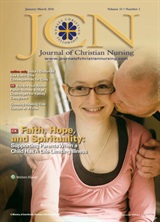
From these deficits in our Christian faith and in nursing, as well is in my own personal/professional life, I decided a discussion on humility was needed.
Check out the article in this issue of JCN
and then spend some time tin prayer and self-reflection in how to bring humility to both your personal life and your nursing practice.
Don’t be too hard on yourself. Humility, like faith is a growth process and we will spend our earthly lives gleaning attributes from our Savior. Just take note where you would like to improve and then allow the Holy Spirit to direct you accordingly.
This is a republish of an NCFI Cares for Christmas from December, 2015. Enjoy!
One of the amazements of the Nativity story is the angels’ announcement to the shepherds in Luke 2:9-15. I have taken creative license in imagining how the scene unfolded:
Heaven is buzzing with excitement. It is about to occur. Jesus will become human. Even though the angels are informed of this great mystery and the significance of salvation, they are filled with wonder and anticipation.
“How long does it take for a little human to be born?” one angel asks. “Why can’t God just make one, like Adam and Eve?”
“I can’t wait” says another. “There hasn’t been this much heavenly excitement since the creation of the Heavens and Earth and the miracles in Egypt.”
“Wait!” says a third angel. “What if the humans miss it? The wise men are on their way, but what if they are the only ones who come to see this miraculous event?”
“I am sure there will be other people who will come and worship the Son,” responds another angel. “After all, God has given them many signs of what to look for”
A shout arises from the angels, “It is time! Mary is giving birth!” An overzealous angel, unable to contain his excitement, bolts to earth. The angel finds himself hovering over shepherds in the field and at a loss of what to say or do. Uh, oh! The angel thinks, I have messed up!
Looking for a clue of what to do next, the angel notices the fear on the shepherds face.
“Don’t be afraid!” the angel nervously says. Trying his best to reassure the terrified shepherds. “Listen carefully” says the angel. His confidence is building and the words are flowing. Thank you God, I know what to say! So with renewed confidence, the angel continues. “For I proclaim to you good news that brings great joy to all the people: Today your Savior is born in the city of David. He is Christ the Lord.”
“This will be a sign for you: You will find a baby wrapped in strips of cloth and lying in a manger.” The angel notices the sky is suddenly filled with other angels and together they rejoice: “Glory to God in the highest, and on earth peace among people with whom he is pleased!”
The angel returns to heaven feeling assured knowing that all of earth, throughout eternity will know the significance of the Son’s birth!
Merry Christmas!
The Angel Appearing to the Shepherds, by Thomas Cole, c. 1833-34. Chrysler Museum of Art, Norfolk, Virginia, United States
E is for Earnest— is a reminder to be earnest with our prayers for nursing. Luke shares Jesus’ timeless teaching about praying with persistence through the story of night time visitor knocking on the door of a friend. Even though the friend is resting comfortably and doesn’t want to get out of bed to answer the door, the persistent banging on the door provokes the friend to answer the door. Jesus summarizes the story with the following lesson:
So I tell you: Ask, and it will be given to you; seek, and you will find; knock, and the door will be opened for you. For everyone who asks receives, and the one who seeks finds, and to the one who knocks, the door will be opened (Luke 11:5-10).
The persistent and probably annoying visitor reminds us to pray earnestly (Romans 12:12). One way is to pray weekly for our institutions/ministry/schools. We can also commit to intercede for our colleagues and staff. Our earnest knocking on the prayer door is not for our needs. Instead it is for the Lord’s will in our workplace, in our profession and within our community of nurses (1 Timothy 2:1). As many of us are well acquainted with, earnest prayers doesn’t guarantee results. Instead, it is more likely to open our hearts to the work of the Holy Spirit in our workplace.
“A persistent spirit brings a Christian to the place where faith takes hold, claims and appropriates the blessing.” (EM Bounds, The Necessity of Prayer p. 49)




 discussion on humility was needed.